“The future will belong not to those who focus on the technology alone but to those who. . . see it as one element of a wider system transformation.”
Sir Michael Barber (2013) in Foreword to Alive in the Swamp
In Alive in the Swamp: Assessing Digital Innovations in Education (2013), Michael Fullan and Katelyn Donnelly elaborated on a push-pull phenomena that has surfaced in modern education. The “push” manifests in a rapid loss of enthusiasm among students as they progress through school systems, along with the growing dissatisfaction of teachers who want to leave the teaching profession altogether. The “pull,” which acts as a counterbalancing force, is the rapid explosion of digital innovations that are impacting education and learning. The amount of global digital information that is created and shared has grown exponentially since 2005:
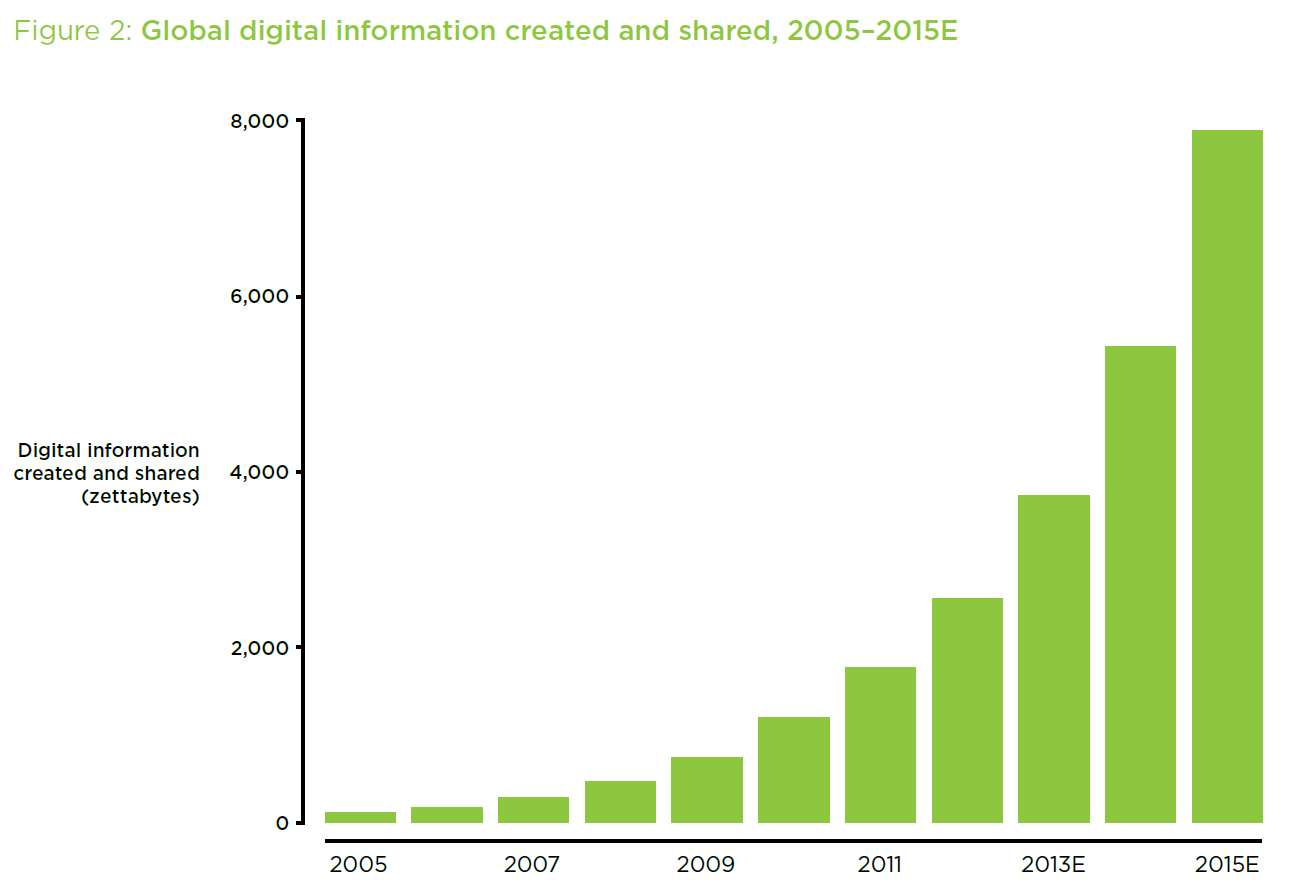 1 zettabyte = 1 trillion gigabytes SOURCE: IDC IVIEW report ‘Extracting value from chaos’. June 2011
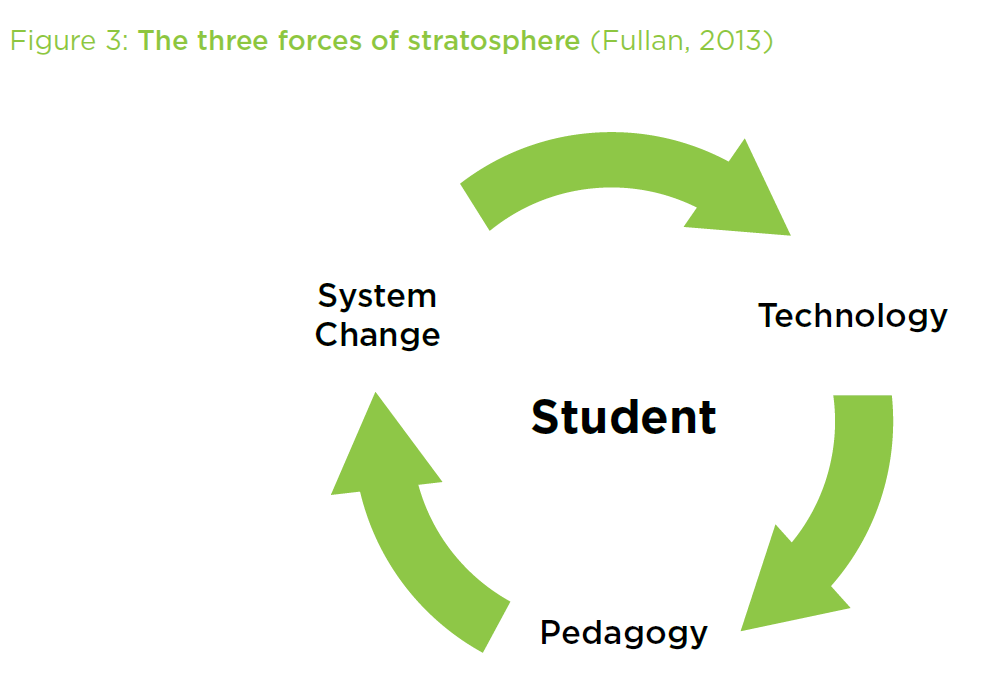
Pedagogy and change knowledge, however, are lagging behind the rapid acceleration of technology. Fullen and Donnelly have stressed that in order to strengthen the new learning revolution, pedagogy and change knowledge will need to “step up their game” (p. 10). Technology needs to be combined with pedagogy and knowledge about system change. In Stratosphere, Fullan (2013) used the following illustration:
 Every year significant investments are being poured into technology for education. Yet how have these investments been viewed? As mere acquisitions? Or as a means of improving and changing the learning system? Where is the evidence to support the claim that digital technologies will improve the education system? In “Decoding learning: the proof, promise and potential of digital education,” Stokes (2012) has called for a shift in focus so that we’re not concentrating simply on the technology itself but on how technology can be used by students for learning. She asserted: “For too long, technology has been put above teaching and excitement has been put above evidence” (p. 63).
Fullan offered four criteria by which to assess new learning systems in Stratosphere (2013):
1. Irresistibly engaging for students and teachers.
2. Elegantly easy to adapt and use.
3. Ubiquitous access to technology 24/7.
4. Steeped in real life problem solving.
In addition, Fullan and Donnelly have developed a comprehensive index that has a practical application. The index has three main components and nine subcomponents. It can be used to systematically evaluate new companies, products, and school models.
Recommendation: Use the index to optimize integration of technology, pedagogy, and “systemness” (p. 26)
References
Barber, M. (2013). Foreword. Alive in the Swamp: Assessing digital innovations in education. NESTA. Retrieved from http://www.nesta.org.uk/sites/default/files/alive_in_the_swamp.pdf
Fullan, M. & Donnelly, K. (2013). Alive in the swamp. Assessing digital innovations in education. NESTA. Retrieved from http://www.nesta.org.uk/sites/default/files/alive_in_the_swamp.pdf
Fullan, M. (2013). Stratosphere: Integrating technology, pedagogy, and change knowledge. Toronto: Pearson Education Inc.

 priming the mind